Moving abroad involves more planning than a domestic move. Here is what you need to know about documentation, customs, and shipping options.
Understand Customs Regulations
Every country has its own customs regulations for personal belongings, covering everything from prohibited items to duty-free allowances for returning citizens or work-permit holders. Research the rules of your destination country thoroughly, or rely on your moving partner for guidance, since regulations can change and vary significantly even between neighboring countries.
Common restrictions include limits on the quantity of electronics, bans on certain food items and plants, and specific rules around firearms, medications, and cultural artifacts. Getting this wrong can result in your shipment being held at customs, additional fees, or in serious cases, confiscation of items — all of which are avoidable with proper research in advance.
Choose Sea or Air Shipping
Sea freight is more economical for large shipments but takes longer, typically four to eight weeks depending on the destination, while air freight is faster, often arriving within one to two weeks, but costs considerably more per kilogram. Choose based on your budget, timeline, and the urgency of specific items.
Many international movers use a hybrid approach: shipping immediate essentials like clothing, important documents, and a few weeks' worth of daily necessities by air, while sending the bulk of furniture and household goods by sea. This balances cost efficiency with the practical need to have some belongings available quickly at your new home.
Planning a move soon?
Get a free, transparent quote from Leo Domestic Packers And Movers.
Prepare Required Documentation
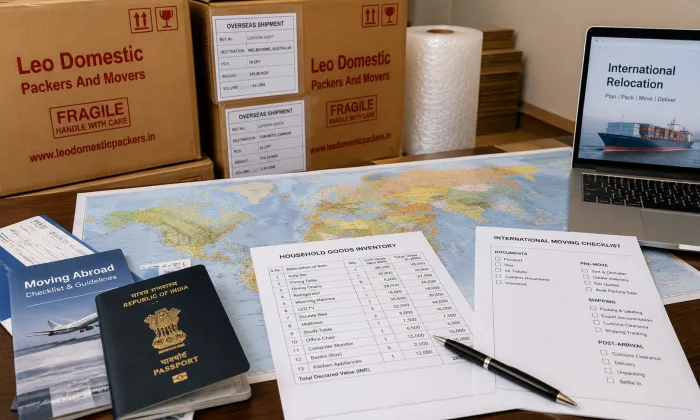
International moves typically require passports, visas, work permits, detailed inventory lists with declared values, and customs forms specific to both the origin and destination country. Keep all documentation organized in both physical and digital copies, readily accessible throughout the move, since customs officials may request them at multiple points in the process.
Start preparing documentation at least six to eight weeks before your intended move date, as some visa and work permit processes can take considerable time, and delays in documentation are one of the most common causes of shipment hold-ups at destination customs.
Decide What to Ship vs. Sell
International shipping costs scale directly with volume and weight, making it worth carefully evaluating which items are genuinely worth shipping versus selling or donating before you leave. Bulky furniture, in particular, is often cheaper to sell and replace at your destination than to ship internationally, especially for moves to countries with different voltage standards or furniture sizing conventions.
A useful exercise is calculating the shipping cost per item category and comparing it to the replacement cost at your destination. Sentimental items and difficult-to-replace belongings are worth shipping regardless of cost, but everyday furniture and appliances often make more financial sense to replace locally.
Get Transit Insurance
International shipments travel long distances and pass through multiple handling points — packing, port or airport transfer, customs inspection, ocean or air transit, and final delivery. Transit insurance protects your belongings against loss or damage during this extended journey, which involves more handling and risk exposure than a typical domestic move.
Given the value of most international shipments and the extended time your belongings spend outside your direct oversight, transit insurance is strongly recommended rather than optional for any international relocation, regardless of how careful your chosen moving partner is.
Plan for Storage at Destination
Your new home abroad may not be ready to receive your full shipment immediately upon arrival, whether due to lease timing, renovation, or visa processing delays. Planning for short-term storage at your destination, either through your moving company's local partners or independent storage facilities, prevents the stressful scenario of belongings arriving with nowhere to go.
Discuss destination storage options with your moving partner early in the planning process, particularly if your move date and your new home's availability date do not align perfectly, which is common with international relocations involving visa or immigration timelines.
Work With an Experienced Partner
An experienced international relocation partner like Leo Domestic Packers And Movers can simplify documentation, customs clearance, and door-to-door delivery by managing the entire chain of logistics rather than leaving you to coordinate multiple vendors independently. This single point of accountability is particularly valuable given how many things can go wrong across an international shipping journey.
When evaluating international movers, ask specifically about their experience with your destination country, their process for handling customs documentation, and whether they provide door-to-door service or only handle origin-side logistics, since some companies stop their responsibility at the port of departure.